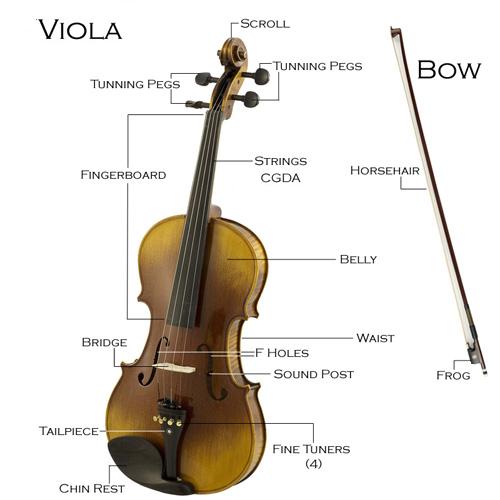
About the Viola
The viola is a bowed instrument that belongs to the violin family. You may tell at first sight it is a violin, but it's not. The viola is slightly larger than the violin and tuned a perfect 5th lower (A-D-G-C, from highest to lowest strings). This provides the viola a deeper, mellower and melancholic tone. Both viola and violin evolved from viola da braccio, but since the italian word violino means "small viola", historians are led to believe that the viola was created before the violin.
As the body of the viola as well as the length of its strings are much larger then a violin's, that makes it much more difficult to play. Thicker and less responsive strings require different bowing technique, and notes being spread out farther along the fingerboard require bigger hands (or longer fingers) and different fingerings.
The viola bow is also heavier than the violin's, it weights 70g to 74g, while the violin's weights 58g to 61g.
In pre-twentieth century works the viola had a frequent limitation, and was most used to play/fill inner harmonies, not enjoying a wide solo repertory like other instruments, specially the violin. Few works before the twentieth century featured the viola as a solo instruments, as we can hear in Berlioz's Harold in Italy and Telemann Viola Concerto in G.
But times have changed, and so has the viola's role in music. Many solo pieces have been written for the viola, and this instrument occasionally has a major role in orchestral music.
Important works featuring the viola from the 20th century on include Bartók's, William's, Schnittke's ,Gubaidulina's concertos, Hindemith's sonatas, and Rebecca Clarke's pieces for viola.
Nowadays we can see viola almost everywhere, in pop music, rock 'n roll bands and in folk music. However, there's still prejudice against the viola. Raise their hand who has never hear those violists jokes. Many violists don't care about them, but never attempt to tell these jokes in the presence of one: the may not like them!