Books
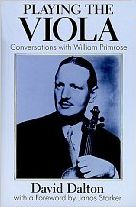
Playing the
Viola - Conversations with William Primrose (by David Dalton and
Janos Starker) Oxford University Press, 1990. Before the death, in 1982, of the renowned violist William Primrose, David Dalton engaged the musician in a lively series of conversations which touched on almost all aspects of viola technique, performance, repertoire, recording, and history. This book is a transcription of this dialogue, containing illuminating advice on holding the viola, bowing, tone, fingering, and practicing, all supported by copious illustrations and musical examples, as well insights on repertoire for the viola--"an instrument without tradition"--and on performances of the great concertos by Bartok and Walton. Punctuated with frankness and humor, this book is a tribute to one of the greatest artists of this century.
|  |
Lionel Tertis: The First Great Virtuoso of the Viola (by John White) Boydell Press, 2007. Lionel Tertis (1876-1975) stands in the company of Ysaÿe, Kreisler, Casals, Thibaud and Rubinstein as one of the greatest instrumentalists - and arguably the greatest viola player - of all time. Such composers as Arnold Bax, Holst, and Vaughan Williams all wrote significant works for him; he was a member of a number of prominent string quartets; and he was later to design and promote his own 'Tertis model' viola. He is virtually synonymous with the increasing importance of the viola as a solo and recital instrument alongside the violin and the cello. This biography, the first full-length survey of his life, tells how he rose from humble beginnings to become 'the father of the modern viola'. It explores in detail his long and distinguished career, persuading composers to write works for the viola, arranging existing works for the instrument, editing and performing the music, teaching and coaching in Great Britain, and his performances in the United States. John White is a prominent viola teacher and performer; in 2000 he was awarded the International Viola Society's highest award for distinguished scholarship and contributions to the viola. |  |
 | Tipbook - Violin and Viola: The best guide to your instrument (The Tipbook Company) 2001. The Tipbook Series books are handy, accessible, thorough and convenient
guides for players who want to get the most out of their instrument.
They are written in collaboration with and proofread by musicians,
teachers, technicians and other experts - for beginners, students and
advanced players. Features include: lessons, teachers and practicing *
all jargon explained * basic background information * price indications *
the history and the family of the instrument * and more.The violin and
viola book covers topics such as: selecting and play-testing violins and
violas, buying strings, bows and accessories, maintenance and tuning,
as well as a violinist's glossary."Interesting sections on the history
and manufacture ... really, it's all here. The tips on maintenance are
excellent!" (Fiddle On Magazine)
|
I Can Read Music (Suzuki Method International, 1999) These easy-to-read, progressive exercises by Joanne Martin develop a student's reading skills one stage at a time, with many repetitions at each stage. I Can Read Music is designed as a first note-reading book for students of string instruments who have learned to play using an aural approach such as the Suzuki Method, or for traditionally taught students who need extra note reading practice. Its presentation of new ideas is clear enough that it can be used daily at home by quite young children and their parents, with the teacher checking progress every week or two. |  |
 | Introducing the Positins for Viola (by Harvey Whistler) Rubank Publications, 1989 Introducing the Positions, a series widely used in classroom and private
studio, represents a critical "next step" for string students. Position
playing allows players to extend range beyond the basics and move into
the ranks of intermediate and advanced ensemble groups. The most
important positions vary for each instrument, and Whistler wisely
introduces the most-used positions first in Volume 1, followed by the
next most important in Volume 2. An irreplaceable component for every
string student's training! |
Carl Flesch Scale System: Scales Exercises in All Major and Minor Keys for Daily Study (Adapted for the viola by Charlotte Karman) Carl Fischer Music Publisher, 1942. Highly recommended to students who wish to improve their skills on the viola, a very helpful tool |  |
1 2
